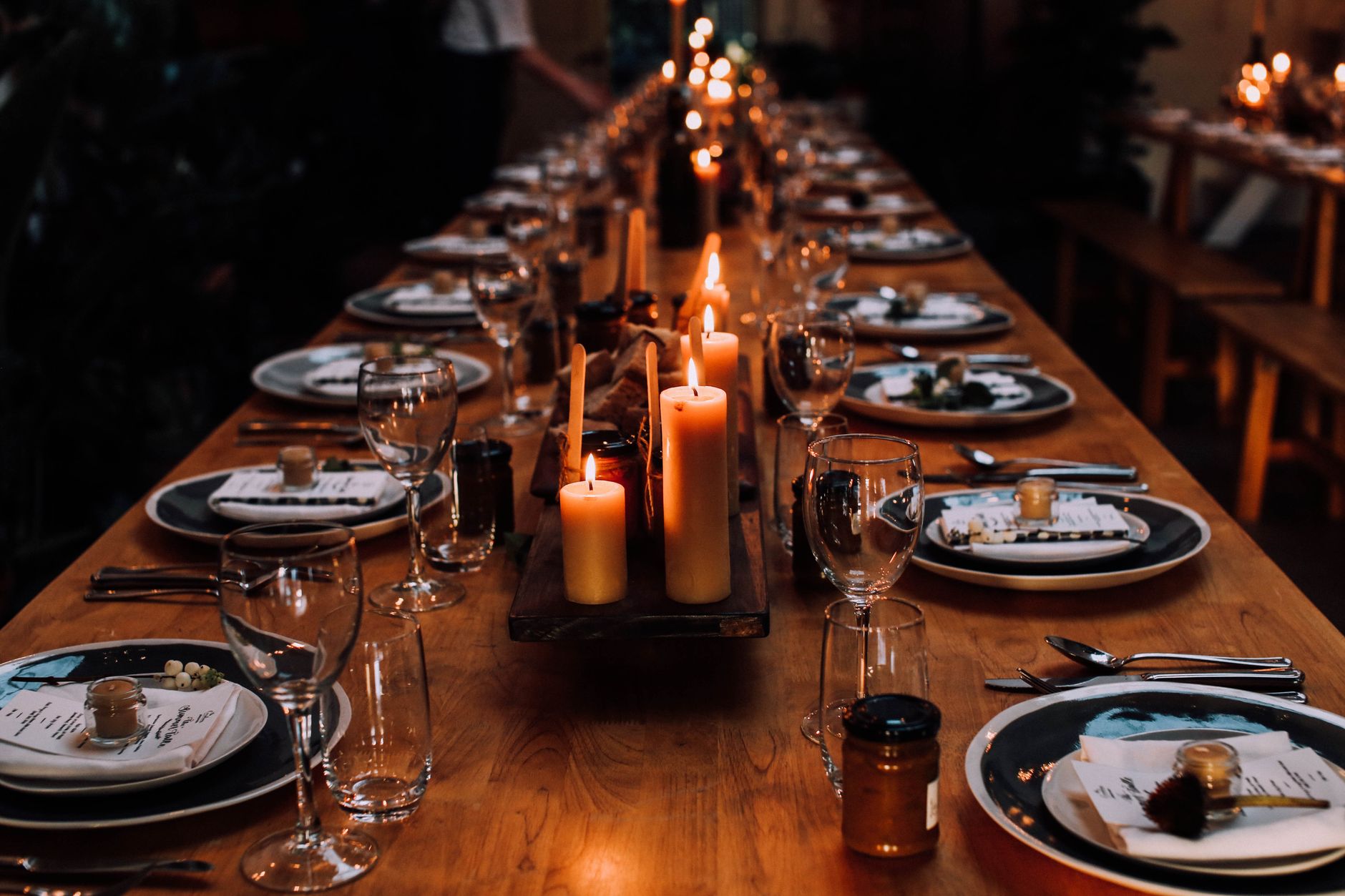
The Bar Was Eleven Feet Too Close, and Nobody Talked
How spatial flow guides conversation at events without guests noticing: where the bar belongs and why chairs should meet at corners.
The bar sat eleven feet from the door, and for the first fifty minutes nobody spoke to a stranger. Spatial flow guides conversation by deciding, before anyone has taken off a coat, where a guest will pause and whose shoulder will be beside theirs when they do. In October 2024 I curated a supper for 64 people in a former rope works in Leith, and I watched couple after couple collect their wine and turn straight back toward the entrance, as if they were waiting for a train. At 7:40 we dragged the bar, a 2.4 metre oak trestle that took four of us to lift, to the far wall under the windows. By eight the room was loud in the way you want a room to be loud.
My position is a little unfashionable: the furniture plan matters more than the guest list. Good flow goes unnoticed. Ask guests afterwards why a night felt easy and they'll credit the food or the host's laugh. They never mention that the chairs met at corners, or that the bar was a twelve-step walk from the door. That's the point. Spatial design works on conversation the way temperature works on mood, felt and never seen. Most of what I know about it I learned dragging trestles across floors at the last minute, usually in shoes nobody should lift furniture in.
The first ten feet decide who talks to whom
Watch a doorway long enough and you'll see the same small ritual. A guest steps in, slows, looks for the light, and checks what their hands should be doing. That pause lasts maybe four seconds. Whatever they find in it, a tray of glasses or a long empty stretch of floorboard, sets the shape of their next hour.
Most hosts crowd that threshold. They put the welcome table there, along with the coat rail, the bar and sometimes the flowers, because it feels generous to meet people with everything at once. It isn't. A packed entrance turns arrival into a queue, and in a queue people only talk to the person they came with. I've seen this pattern at gallery openings, and once at a product launch in a Lisbon tile factory where the brand insisted on a step-and-repeat wall three paces in from the door. Nobody got past it for forty minutes. The room behind it, which had cost a fortune to light, sat empty like a stage before curtain.
Give people somewhere to land
What works, at least in my experience, is a soft landing a few metres in. The floor opens up there, and someone hands you something without asking you to choose. The bar, which is the real engine of any room, goes deep: far wall, or the corner diagonal from the entrance. People walk to it. In walking they cross the room, and crossing the room is how you catch sight of the person you didn't know you'd end up talking to until midnight.
- Keep the first three metres clear of anything that makes people stop and decide.
- Put the bar at the farthest point from the door that still has decent sightlines.
- Hand the first drink over on a tray, so arrival asks nothing of anyone.
- Move the coat rail outside the room if the building allows it.
Corners talk, rows stay silent
In 1959 the psychologist Robert Sommer sat in a hospital cafeteria and counted who spoke to whom. His finding, published in Sociometry, is the one I'd tattoo on every planner's wrist. People seated corner to corner, at right angles, held about twice as many conversations as people seated directly across from each other, and roughly six times as many as people sitting side by side.
It makes sense once you sit in it. Across a table, you're confronted. Side by side, you're both staring at the same wall like passengers on a bus. At ninety degrees you can look at someone and then look away, at the candle, at the heel of bread on your plate, without it meaning anything. The angle gives you permission to be quiet, and people who are allowed to be quiet usually end up saying more.
The arithmetic of a lounge
Edward Hall's work on proxemics in the 1960s put personal distance at roughly 45 centimetres to 1.2 metres, the range where friends talk, with social distance running out to about 3.5 metres beyond that (Proxemics overview). I use those numbers more than any mood board. A lounge cluster with chairs 2.5 metres apart is a waiting room. Pull them in to about a metre, knee to knee across a low table, and the same four strangers start passing the olives.
Long banquet tables are the exception people ask me about. I'm fond of them, but they work for a different reason. You're never talking to the whole table, only to the few people within reach, so a long table is really a chain of small rooms. Keep it under about 90 centimetres wide or the person opposite drifts out of range, and you're back to talking to your own elbow.
Moving a crowd without anyone feeling pushed
Distance doesn't only shape a single table. It shapes the whole night. Thomas Allen at MIT found in the 1970s that the chance of two engineers communicating weekly fell steeply with distance, close to nothing once their desks sat more than about 50 metres apart, a relationship Harvard Business Review revisited in 2014 with sensor data from real offices. An event is a compressed office with better wine. If your two crowds settle at opposite ends of a long room, they'll never meet, however good the pour.
So I move them. Not with signs. With pull. A second, smaller bar opens at nine at the end of the room nobody has touched. The cellist starts in the courtyard instead of the hall. Light in the first room drops a few percent every fifteen minutes, which almost no one registers, and the warm room next door begins to feel like the obvious place to be. Scent works too, though more quietly than people think... beeswax near a doorway reads as an invitation, and a fig candle by the dessert table draws people over ten minutes before the plates arrive.
“How spatial flow guides conversation at events without guests noticing: where the bar belongs and why chairs should meet at corners.”
I'll admit the scent part is what I'm least sure about. My friend Delara tried it at her fortieth, she'd read about it somewhere, and put a sandalwood diffuser by the terrace door to coax people outside. Honestly, half the guests went out, and the other half went out looking for whatever was burning, because the diffuser was sitting on a radiator. Her uncle unplugged it. I think it still sort of worked? People did end up on the terrace. I just can't tell you whether that was the sandalwood or the mild panic.
Rhythm, not choreography
The mistake is treating this like stage blocking. Guests aren't actors, and they can feel a hand on their back even when there isn't one. One deliberate shift per hour is plenty. More than that and the room starts to feel managed, which defeats the purpose.
Where invisible flow falls apart
None of this works on everyone, and I've stopped pretending it does. Some guests read a room's pull and resist it on principle. Others, often the people who find crowds tiring, need an edge more than a centre: a wall at their back and a clear view of the door. If you engineer every surface toward mingling, those guests leave at nine and you never find out why. I lost a whole table of architects that way in 2022, at a dinner where I'd removed every wall-side seat to keep the room open. They were polite about it. They were also gone before the fish.
The common misconception is that open space creates conversation. It doesn't. An empty ballroom with cocktail tables dotted evenly across it is the loneliest floor plan there is, because every position is equal and none of them is anywhere. Conversation needs edges and pinch points. People gather at columns, and where a corridor narrows. The end of the bar gets more talk than the middle ever will.
And there's a real argument, one I have with a curator friend in Copenhagen every year or so, about whether invisible design is a little manipulative. She thinks guests deserve to know they're being moved. I think the fact that they can't feel it is the courtesy... nobody wants to see the stagehands. But I'll grant her this much. The moment a guest catches the trick, say a host steering them by the elbow toward 'someone you simply have to meet', the spell breaks and the room becomes a networking event. My answer is redundancy. Give every space a reason to linger and a reason to leave, then let people choose. Flow should feel like weather. Nobody blames the weather for where they ended up standing.
Before your next gathering, arrive an hour early, pour yourself a glass, and walk in through the front door the way a stranger would. Stop where your body wants to stop. If that spot is within three metres of the entrance, move whatever is holding you there, the bar or the welcome table, deeper into the room, and angle at least half the chairs so they meet at corners. Then stand by the far wall and wait for the first guest. You'll see it in their shoulders: the small turn toward the light, and then the room beginning to sound like something.
Kanona Projects is for curious minds who believe a gathering can be more than a social obligation. The people who show up wanting to feel something different - and leave carrying a memory they did not expect.
Frequently asked questions
How do you get guests to mingle at an event without forcing it?
Move the bar to the far side of the room and keep the entrance clear, so people have to cross the space to get a drink. Angle seating so chairs meet at ninety degrees. In Robert Sommer's research, that arrangement produced far more conversation than face-to-face seating.
How far apart should lounge chairs be for conversation?
About a metre between knees, roughly the outer edge of what Edward Hall called personal distance. Past two metres a cluster stops feeling like a conversation and starts feeling like a waiting area.
Where should the bar go at a party?
Deep in the room, ideally on the far wall or in the corner diagonal from the door, with clear sightlines. A bar near the entrance creates a queue, and people in a queue only talk to the people they arrived with.